Bukchon Hanok Village Guide: Photo Spots, Etiquette & Cafes
Facts checked: 2026-08-037 min read
By Korea Visit Guide Editorial · Published · Updated
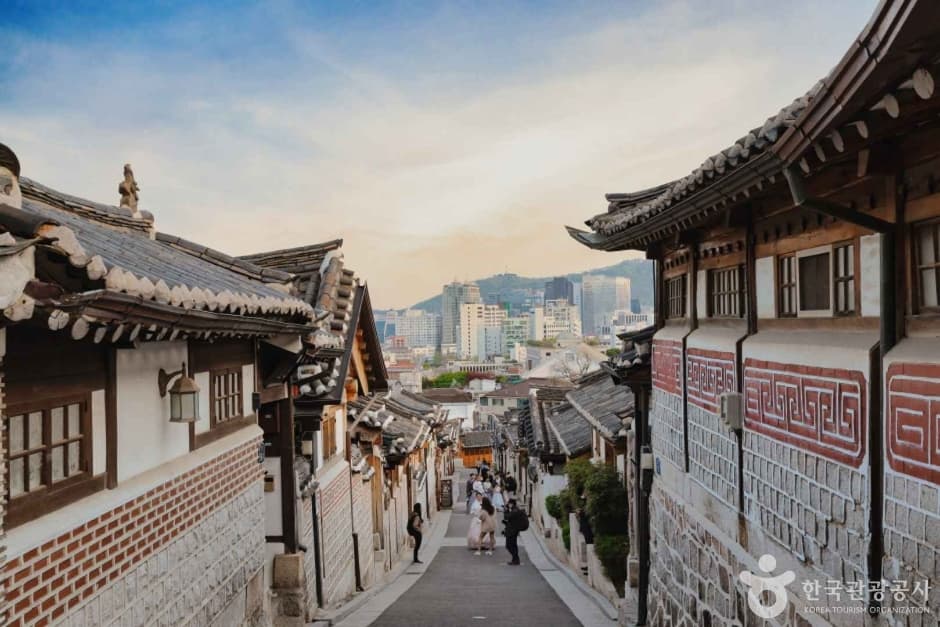
Bukchon Hanok Village Guide: Photo Spots, Etiquette & Cafes
Contains affiliate links
Stay connected in Korea
Get a Korea travel eSIM before you land — data works the moment you arrive, no SIM swap.
Contains affiliate links
Bukchon Hanok Village (북촌한옥마을) looks like a museum but functions as a working neighborhood — around 6,100 residents share their streets with millions of visitors a year, and the local government has responded with enforceable rules. Here's exactly where to shoot photos, what you're legally required to do, and where to get coffee afterward.
Where to Go for the Best Photo Alleys
The single most photographed lane in Bukchon is the sloped street on Bukchon-ro 11-gil, where cascading tiled hanok roofs line up with the Namsan Tower skyline in the background — it's the shot you've seen on Instagram and Naver blogs a thousand times. The catch: this exact lane is also the neighborhood's most tightly regulated stretch (more on that below), so you can only shoot it during official visiting hours.
For a calmer alternative, head into Gahoe-dong (가회동), which the official Seoul tourism site actually recommends over the busier lanes: <cite index="8-4">"The best place within Bukchon to experience the old hanok atmosphere may be Gaehoe-dong. Here, hundreds of hanok sit shoulder to shoulder."</cite> It's quieter, has fewer tour groups, and still delivers the classic rooftop-and-alley composition.
Gyedong-gil (계동길), the street running down from the Bukchon Cultural Center toward Anguk Station, is a good "working" alley — it mixes hanok facades with small shops and cafés, so you can shoot street-level photos without walking past anyone's front gate. It's also where you'll find casual lunch spots like the udon shop near Anguk Station exit 3.
Practical tip: bring a fully charged phone and download offline maps before you arrive, since alley names change block by block and GPS can wobble between narrow lanes. If you haven't set up mobile data yet, grab a Korea eSIM before you land so Naver Map or Google Maps works the moment you land — our Naver Map guide for foreigners covers the app setup in more detail.
The Visiting-Hour Curfew You Must Know About
This is the rule that catches most first-time visitors off guard. Since March 2025, Jongno-gu has enforced a hard curfew on Bukchon's busiest lane. <cite index="7-1">The Red Zone is the residential hanok area of about 34,000 m² around Bukchon-ro 11-gil, the most crowded lanes.</cite> <cite index="4-1">Tourists can visit the popular historical residential area only between 10 a.m. and 5 p.m., facing a 100,000-won ($76) fine for those who enter outside these hours for tourism purposes.</cite>
The good news: the fine doesn't apply to everyone. <cite index="7-3">The rule targets tourism — sightseeing, taking photos, or wandering the lanes — while residents and their family and guests, customers of shops inside the zone, guests staying at accommodations there, local merchants, and people simply passing through are not fined.</cite> In practice, that means <cite index="7-4">shopping, staying overnight, or walking through are fine; tourist sightseeing should happen 10:00 to 17:00</cite>.
That overnight exemption is worth planning around. If you want the empty-alley photos everyone else misses, booking a guesthouse or hotel inside or near Bukchon lets you legally walk those lanes before 10 a.m. or after 5 p.m., when the crowds and enforcement patrols have cleared out.
Enforcement is genuinely active, not just signage: <cite index="3-1,3-2">as the clock hits 5 p.m. every day, the mood shifts in Bukchon — crowds thin, cameras lower, and officials known as Bukchon Guardians begin walking the narrow alleys, gently reminding visitors that it's time to leave.</cite>
Noise, Privacy, and the Other Etiquette Rules
Beyond the Red Zone curfew, Jongno-gu has layered in additional "special management" rules covering noise and crowding across a wider area. The busier connecting streets — Bukchon-ro 5-gil and Gyedong-gil — are managed as monitoring zones where officials focus on noise-making visitors rather than enforcing a curfew, while a smaller stretch of Bukchon-ro 12-gil gets stepped-up guidance after resident complaints spike.
The general rules that apply everywhere in Bukchon:
| Rule | Detail |
|---|---|
| Visiting hours (Red Zone, Bukchon-ro 11-gil) | 10:00 a.m.–5:00 p.m. only; ₩100,000 fine for tourists outside these hours |
| Group size | <cite index="9-2">Keep group sizes small — fewer than 10 people per group</cite> |
| Noise | Keep voices down; no loud speakers, tour-guide megaphones, or shouting between group members |
| Chartered buses | <cite index="2-1">No chartered buses are allowed in the designated 2.3 km area (Bukchon-ro, Bukchon-ro 5-gil, and Changdeokgung 1-gil)</cite> |
| Privacy | Don't open gates, peer into windows, or photograph residents or their doorways without permission |
| Litter | Carry out your own trash; there are few public bins in the residential lanes |
Seoul's own tourism messaging frames this as a "silent tourism" ask rather than a punishment: <cite index="8-7">"We ask for your cooperation in practicing 'silent tourism.'"</cite> It matters because the numbers are lopsided — <cite index="9-1">in 2024, the area received 6.4 million visitors, compared to around 6,100 residents in the village</cite>. Treat every lane as someone's front yard, because it is.
Best Time to Visit for Photos Without the Crowds
Arrive right at the 10 a.m. opening on a weekday (Tuesday–Thursday) for the quietest light and the shortest wait for that classic Bukchon-ro 11-gil shot. Weekends and the last hour before the 5 p.m. cutoff get noticeably busier as everyone rushes to squeeze in a visit. Early autumn and spring mornings also give the cleanest air for the Namsan Tower backdrop shot.
Wearing hanbok is common and encouraged here — many visitors combine a Bukchon walk with a rental, since the flowing fabric photographs well against the tiled roofs. If you're pairing this with Gyeongbokgung or Changdeokgung the same day, check our hanbok rental guide for pricing and palace fee waivers before you book.
Cafés and Tea Houses Near Bukchon
Once you're done shooting alleys, two directions make sense for a coffee break:
North toward Samcheong Park: Samcheong-dong-gil (삼청동길), the road connecting Bukchon to Samcheong Park, is lined with small independent cafés, many with garden patios or rooftop seating that look back over the hanok rooftops. It's a genuinely different vibe from the residential lanes — commercial, café-dense, and fine to be loud in.
Near Anguk Station (exits 2–3): several renovated hanok around the station now house bakery-cafés, and the Gyedong-gil strip has casual lunch spots between the photo stops — a self-serve udon shop near exit 3 is a popular, quick option if you need a real meal rather than just coffee. The nearby Jeongdok Public Library grounds (a former school site) also make a free, shaded spot to rest between café visits.
If you'd rather build café-hopping into a full day around the palaces and tea houses of the district, see our Jongno and Insadong travel guide for the wider area beyond Bukchon itself.
Getting There
Take Seoul Subway Line 3 to Anguk Station, exits 2 or 3, and walk north — most of Bukchon's photo alleys are within a 10-minute walk. Taxis can drop you near the station entrance but can't enter the narrow residential lanes, and chartered buses are banned from the core streets entirely, so don't plan a tour-bus stop here. If you're new to the subway system, our Seoul subway guide covers line transfers and fares.
Bottom Line
Bukchon rewards visitors who treat it like a neighborhood rather than a theme park: shoot the Bukchon-ro 11-gil view between 10 a.m. and 5 p.m., keep your group small and quiet, and finish with coffee on Samcheong-dong-gil or near Anguk Station. Skip the curfew violation and the ₩100,000 fine by planning your visit — or your overnight stay — around the posted hours.
Bukchon Hanok Village Guide: Photo Spots, Etiquette & Cafes
Contains affiliate links
Quick answers
What time does Bukchon Hanok Village close to tourists?
The most-photographed lane, the "Red Zone" around Bukchon-ro 11-gil, is open to tourists only from 10 a.m. to 5 p.m. Entering for sightseeing or photos outside these hours can result in a ₩100,000 fine. Residents, shop customers, and overnight guests staying in the zone are exempt.
Is Bukchon Hanok Village free to visit?
Yes — Bukchon is a public residential neighborhood with open streets, not a ticketed attraction. There's no entrance fee, but the visiting-hour restriction on the busiest lane and noise/group-size rules still apply since real families live there.
Where is the best photo spot in Bukchon Hanok Village?
The sloped street on Bukchon-ro 11-gil, with tiled hanok roofs cascading toward the Namsan Tower skyline, is the classic shot. For a quieter alternative with the same traditional atmosphere, Gahoe-dong is recommended by Seoul's own tourism office.
Can I take a tour bus to Bukchon Hanok Village?
No. Chartered buses are banned from the core 2.3 km area covering Bukchon-ro, Bukchon-ro 5-gil, and Changdeokgung 1-gil due to congestion and illegal parking. Take the subway to Anguk Station (Line 3, exits 2-3) and walk in instead.
Neighborhoods
Itaewon Guide: Restaurants, Nightlife and Halal Food
Itaewon travel guide for foreigners: best restaurants, halal food near Seoul Central Mosque, bars, clubs, and safety tips for Seoul's most diverse district.
Facts checked: 2026-08-04 · 7 min read
Ikseon-dong Hanok Cafes: Where to Go and What to Expect
A local's guide to Ikseon-dong hanok cafes: standout spots, the alley layout, crowd timing, and how it differs from Bukchon and Insadong.
Facts checked: 2026-08-03 · 7 min read
Lotte World Aquarium Jamsil: 1.5-2 Hours, Tower & Sky
Lotte World Aquarium takes 1.5 to 2 hours to see comfortably — it's on B1 of Lotte World Mall, steps from Lotte World Tower, Seoul Sky & Seokchon Lake.
Facts checked: 2026-09-14 · 6 min read
Latest guides
E-Scooters & Bike-Share in Korea: Riding Without a Korean ID
Can tourists use Ttareungyi, GCOO or Kakao T Bike without a Korean ID or license? Here's what actually verifies, and where e-scooters legally require one.
Facts checked: 2026-09-16 · 6 min read
Free & Discounted Jeju Flights for Foreign Tourists
How Jeju flight discount campaigns for foreign tourists actually work, who qualifies, and how to book the cheapest legitimate seat as an independent traveler.
Facts checked: 2026-09-15 · 6 min read
Seoraksan Day Trip from Seoul: Bus, Tours & Cable Car Timing
How to visit Seoraksan National Park from Seoul in a day: express bus times, guided tour options, cable car tickets, and a realistic hour-by-hour plan.
Facts checked: 2026-09-14 · 7 min read
Hire a Personal Shopper in Seoul: Cost, Inclusions, Booking
Hiring a personal shopper in Seoul costs around ₩70,000-₩200,000 per hour. What's included, which district to pick, and how to book, explained.
Facts checked: 2026-09-13 · 6 min read