Jongno and Insadong Travel Guide: Palaces, Hanok and Tea Houses
Facts checked: 2026-07-197 min read
By Korea Visit Guide Editorial · Published · Updated
Jongno and Insadong Travel Guide: Palaces, Hanok and Tea Houses
Contains affiliate links
Stay connected in Korea
Get a Korea travel eSIM before you land — data works the moment you arrive, no SIM swap.
Contains affiliate links
Where Jongno and Insadong Sit, and How to Get There
Jongno-gu (종로구) is Seoul's historic administrative center, and Insadong (인사동) is the antique-and-tea-house street tucked inside it. The whole district clusters around two subway stops on Line 3: Anguk Station (안국역, Exit 6 for Insadong and Bukchon) and Gyeongbokgung Station (경복궁역, Exit 5 for the palace's front gate). Jongno 3-ga Station (종로3가역, Lines 1, 3, 5) covers the eastern end near Jogyesa Temple and the older food alleys.
If you're unsure how to read the subway map or transfer between lines, see How to Use the Seoul Subway: Lines, Transfers, Apps. For getting oriented once you're above ground, How to Use Naver Map in Korea as a Foreigner is worth reading before you land here, since Google Maps' walking directions are unreliable in Korea.
This isn't where most visitors sleep — it's a sightseeing district, not a nightlife or shopping base like Myeongdong or Hongdae. If you're still deciding where to stay overall, check Best Areas to Stay in Seoul: An Honest Neighborhood Comparison.
Gyeongbokgung, Changdeokgung and Changgyeonggung Compared
Three of Seoul's five grand palaces sit within or near this district, and visitors often only have time for one or two.
| Palace | Highlight | Entry Fee | Best For |
|---|---|---|---|
| Gyeongbokgung (경복궁) | Largest palace, changing of the guard ceremony, National Folk Museum on site | around ₩3,000 (free if wearing hanbok) | First-time visitors, photos |
| Changdeokgung (창덕궁) | UNESCO-listed, Huwon "Secret Garden" (guided, timed-entry) | around ₩3,000 palace / +₩5,000 garden | Those who want fewer crowds and nature |
| Changgyeonggung (창경궁) | Smaller, quieter, connects to Jongmyo Shrine woods | around ₩1,000 | A relaxed second palace, less crowded |
Gyeongbokgung's changing-of-the-guard ceremony runs a few times daily near Gwanghwamun Gate — check the official Cultural Heritage Administration site for the current schedule, since times shift seasonally. Changdeokgung's Secret Garden requires a separate timed, guided-tour ticket that can sell out on weekends, so book same-day or in advance through the official site if possible.
Most palaces are closed one day a week (usually Tuesday) — always confirm before you go, since this rotates by site.
Bukchon Hanok Village: A Living Neighborhood, Not a Museum
Bukchon Hanok Village (북촌한옥마을) sits on the hillside between Gyeongbokgung and Changdeokgung and is one of the few places in Seoul where traditional hanok houses are still lived in, not just preserved as exhibits. The famous photo spots (Bukchon 8th viewpoint and similar numbered alleys) are on quiet residential streets — signs asking for silence after certain hours are real requests from residents, not decoration.
Go early morning (before 10am) or late afternoon to avoid tour groups. Hanbok rental shops near Anguk Station exit 2-3 rent traditional outfits for around ₩15,000-30,000 for a few hours; wearing one gets you free palace entry and better photos on the hanok streets.
This area pairs naturally with a broader multi-day plan — see the 5-Day Seoul Itinerary: A Realistic Plan by Neighborhood for how to sequence it with the rest of the city.
Insadong: Tea Houses, Galleries and Traditional Shopping
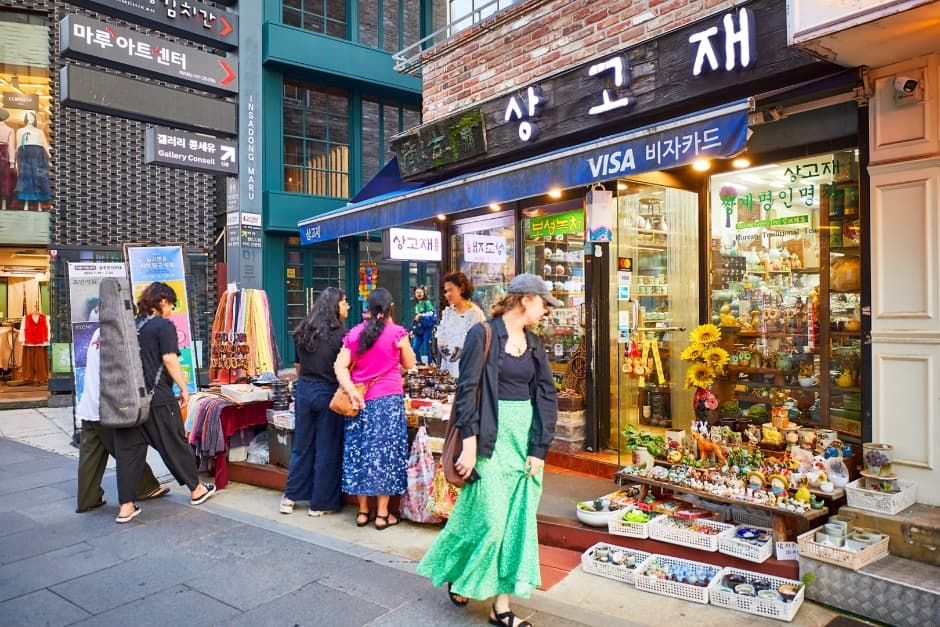
Insadong-gil (인사동길) is the pedestrian-friendly main street lined with galleries, calligraphy shops, hanji (traditional paper) stores, and tea houses. It's touristy but still one of the better places in Seoul to buy actual Korean crafts rather than mass-produced souvenirs — look one block off the main road for smaller, cheaper shops.
Traditional tea houses (전통찻집) here serve omija-cha (five-flavor berry tea), yuja-cha (citron tea), and ssanghwa-cha (herbal tea, often served with a raw egg yolk on top) in hanok-style interiors, typically around ₩8,000-13,000 per cup. These are sit-down, slow-paced spots — good for a rest between palaces, not a quick coffee run.
Ssamziegil (쌈지길), a spiral-shaped courtyard mall mid-street, is worth a walk-through for independent design shops and small cafés even if you don't buy anything.
Jogyesa Temple and Food Near Jongno 3-ga
Jogyesa Temple (조계사), a short walk from Insadong's north end, is the head temple of the Jogye Order and one of the few major temples inside central Seoul. It's free to enter, active (not just a tourist site), and worth 20-30 minutes, especially if a ceremony is in progress.
East toward Jongno 3-ga Station, the food gets less touristy and cheaper. This pocket has old-school Korean BBQ alleys, sundae-guk (blood sausage soup) stalls, and Gwangjang Market's older, more local cousin stalls — a contrast to the polished restaurants of Myeongdong. If you want to book ahead at any sit-down spot in the area, see How to Book Restaurants in Korea: Catch Table, Naver, Walk-Ins.
Practical Tips for Visiting Jongno and Insadong
- Order of visits: Gyeongbokgung → Bukchon → Insadong → Jogyesa flows naturally west to east and takes a full day at a relaxed pace.
- Combination tickets: A discounted multi-palace pass covering four palaces plus Jongmyo Shrine is sold at palace ticket booths — worth it if you plan to see more than two sites.
- Crowds: Weekends and Korean public holidays bring large tour groups to Gyeongbokgung and Bukchon; weekday mornings are noticeably quieter.
- Dress: Hanbok rental gets free palace entry, but check each palace's current policy since rules occasionally change.
- Payment: Most palace ticket booths and tea houses take cards, but small hanji shops and street stalls may be cash-preferred — see How to Pay in Korea as a Tourist for details.
Jongno and Insadong Travel Guide: Palaces, Hanok and Tea Houses
Contains affiliate links
Quick answers
How much time do I need for Jongno and Insadong?
A full day covers one palace, Bukchon Hanok Village, and Insadong at a relaxed pace. If you want Changdeokgung's Secret Garden or a second palace, split it into two half-days rather than rushing.
Which palace should I choose if I only have time for one?
Gyeongbokgung is the largest and most photogenic, with the changing-of-the-guard ceremony, making it the best first choice. Choose Changdeokgung instead if you specifically want the Secret Garden and smaller crowds.
Is Insadong worth visiting if I'm not interested in shopping?
Yes. The traditional tea houses, Jogyesa Temple, and Ssamziegil's architecture are worth a walk-through even without buying anything, and it connects easily on foot to Bukchon and Gyeongbokgung.
Do I need to book palace tickets in advance?
Regular palace entry can usually be bought same-day at the gate. Changdeokgung's Secret Garden tour uses timed, limited tickets that can sell out on weekends, so book ahead online through the official site when possible.
Neighborhoods
Jongno 3-ga Nightlife Guide: Pojangmacha & Hanok Bars
Jongno 3-ga nightlife guide: pojangmacha tent alleys, hanok bars in Ikseon-dong, exits, hours, prices and where the after-dark crowd actually goes.
Facts checked: 2026-09-29 · 6 min read
Namdaemun Market Guide: What to Buy, Eat & vs Myeongdong
A Namdaemun Market guide for tourists: what to buy, what to eat, and how it's genuinely different from a Myeongdong shopping trip.
Facts checked: 2026-09-26 · 6 min read
Itaewon Guide: Restaurants, Nightlife and Halal Food
Itaewon travel guide for foreigners: best restaurants, halal food near Seoul Central Mosque, bars, clubs, and safety tips for Seoul's most diverse district.
Facts checked: 2026-08-04 · 7 min read
Latest guides
Yeoju Premium Outlets Shuttle Bus: Seoul Day Trip Guide
How to get the Yeoju Premium Outlets shuttle bus from Seoul, grab the foreigner discount coupon, and store luggage before shopping. Routes, times, prices.
Facts checked: 2026-10-20 · 7 min read
How to Book K-League Football Tickets in Korea
How to find K-League match schedules and buy football tickets in Korea: official sites, stadium box offices, prices, and English-language support.
Facts checked: 2026-10-18 · 5 min read
Hiking Bukhansan as a Tourist: Easiest Routes & Subway Access
Hike Bukhansan as a first-timer: the easiest beginner trails, the gear to pack, and which subway station gets you to each trailhead.
Facts checked: 2026-10-15 · 6 min read
Where to Stay in Jeju: Jeju City vs Seogwipo vs Aewol
Compare Jeju City, Seogwipo, and Aewol to pick the right home base for your first Jeju trip based on attractions, nightlife, and drive times.
Facts checked: 2026-10-13 · 6 min read